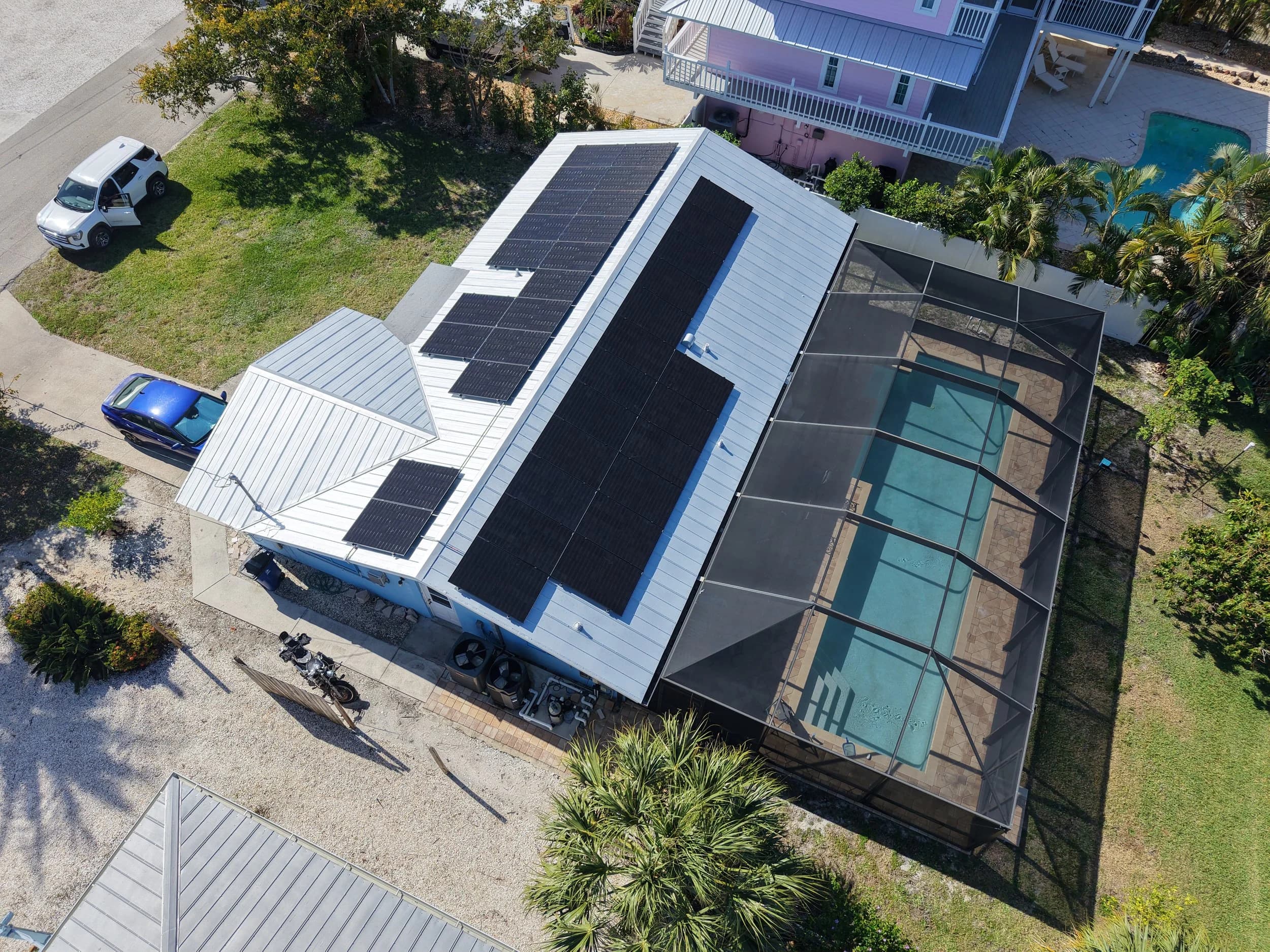
Solar's coming to Florida. The only question is where.
The utilities are building solar by the gigawatt — that part's settled. What isn't settled is whether it goes on farmland and open habitat, or on the roofs and parking lots we've already built. Here's the honest case for starting with your roof — no hype, no 'free solar,' just the numbers and the trade-offs.
Rooftops first. Everybody wins — and nobody has to pretend.
You win
Solar can lock in part of your electricity cost so it stops climbing with your utility's rates. Add a battery and you keep the fridge, the CPAP, and the lights on when the grid goes down in storm season. Owned systems tend to add resale value too.
Savings are a range, not a promise — and in 2026 there's no federal residential tax credit, so we run your real numbers.
The grid wins
Power made on your roof travels a shorter distance, so fewer electrons are lost on the wires — and your output peaks in the afternoon, right when Florida's grid works hardest. Enough rooftops can help the whole system defer some expensive upgrades.
We're careful here: your utility doesn't necessarily profit from your panels. The real winner is a leaner, more resilient grid.
Florida wins
Solar is coming to Florida no matter what — the utilities are building it by the gigawatt. The only question is where. Utility-scale solar takes 7–9 acres of land per megawatt, and Florida's build-out is landing on farmland and rural tracts, including habitat conservationists have flagged. Every roof and parking canopy we light up is land that doesn't get cleared somewhere else.
Rooftops and parking lots first.
Why homeowners actually pull the trigger
Not a sales list — the honest reasons, with the caveats attached. Anything with a number is a cited estimate, never a guarantee.
A hedge against rising rates
Utility rates tend to climb over time; rooftop solar fixes part of your cost at today's price. (A range — depends on your usage, rate, and financing.)
Full-retail net metering (FPL/Duke/TECO)
In Florida's big investor-owned utilities, excess power you export is currently credited at the full retail rate — one of the friendlier export deals in the country. (Co-ops like LCEC set their own terms.)
Hurricane-season resilience
Panels plus a battery keep essentials running through outages — a defined number of hours, not off-grid forever. Real value in storm country.
Measurable resale value
Studies find owned solar adds resale value — on the order of ~4% (Zillow) or a few dollars per watt (Berkeley Lab). Varies by market; leased systems behave differently.
Rooftops spare open land
Utility-scale solar uses ~7–9 acres per megawatt. Your roof uses space that's already built — NREL estimates U.S. rooftops alone could supply nearly 40% of the country's electricity.
Predictable long-term cost
A paid-off system means decades of largely fixed generation cost — useful for fixed-income and retirement budgeting. Panels are typically warrantied ~25 years.
Businesses & nonprofits still get incentives
Unlike homeowners in 2026, businesses and nonprofits still have federal solar incentives — the ITC, depreciation, and direct pay for tax-exempt orgs.
A second opinion that isn't selling one brand
The biggest reason of all: getting the math checked by an advisor who doesn't sell a single panel — so you only go solar if your numbers actually work.
We won’t tell you they’re paving the Everglades.
They’re not — that’s a myth, and we won’t sell fear. What’s real: Florida’s solar build-out is landing on farmland and rural land, and peer-reviewed research has flagged impacts to wildlife corridors where those big fields go in. Every kilowatt on a roof or a parking canopy is a kilowatt that doesn’t need an acre of field. That’s the whole argument for rooftops first — and it happens to be the option that also lowers your bill.
~7–9 acres
of land per megawatt for utility-scale solar (NREL).
~40%
of U.S. electricity that rooftops alone could supply (NREL) — before clearing a single new field.
Figures are cited estimates (NREL land-use and rooftop-potential studies; peer-reviewed wildlife-corridor research) and describe the industry broadly, not your specific project. Savings vary and aren’t guaranteed; the federal residential tax credit (§25D) ended Dec 31, 2025, so owned home systems get no federal credit in 2026. Backup requires a battery and is finite. We’ll show you your real numbers before you decide.
The point isn’t “go solar.” It’s “check your numbers.”
If your roof, your bill, and your utility line up, solar can be a genuinely good decision. If they don’t, we’ll tell you. Either way you’ll know — for free.
Business or nonprofit? The 2026 math is different — and better. See the commercial case →
See if the numbers work for your roof
A no-pressure comparison of your real options — solar, battery, or staying with the utility — on your actual bill.
We compare the numbers. You decide. If solar isn't right for your property, we'll say so.